Heathenry is often described as "the religion with homework". It's true that, to forge a stable path a lot of reading and research is required. This tends to mean that, up til now, heathenry has attracted a certain type of person. Usually quite academic, interested in history and archaeology, amongst other things. The kind of person who likes to find their own way of doing things - independent and free-thinking. For the most part, this is the kind of person who does well within heathen culture at present.
In addition to, or perhaps because of, this personality type, the contemporary heathen community suffers a little from "too many chiefs and not enough indians". Everyone wants to style themself as a gothi or skald. After all, who would give up the opportunity to carve themselves a position of influence in the relatively small but burgeoning heathen community?
Problem is, the heathen community doesn't quite have the population to support all these leaders, projects and businesses. All the would-be leaders have their own visions and are pulling in their respective directions. Unfortunately, without any lay heathens to whom they can preach, sing or sell, no material progress will ever really manifest.
Take a look at any of the online heathen groups, and there appears to be a lot of industry going on. This fills a lot of people with confidence, but I am not so sure. The activity mostly boils down to people broadcasting their views and talents in the hopes of being recognised in their chosen role. As gothi, skald, artisan or whatever. How many heathens are there who are actually listening to their messages and buying their products? This is the true measure of the health of the heathen community. Not how much is being said, but how many are listening.
Myself, I don't really have dreams of any particular goal or position within my heathenry. I am happy to do my own thing and socialise with heathen friends by sharing important words by the fire. That is enough for me. I tend not to join in with inter-factional disputes. My opinion is that these disagreements will sort themselves out over time. If one gothi promotes daily blots, while another promotes monthly blots that may create a disagreement within the community. However, the winner will not come down to whose opinion is better researched and supported by the lore, or whose UPG makes most sense. It will come down to which option those aforementioned "lay heathens" with no particular skills or titles decide to include as part of their own paths.
You see, at the end of the day, the power is always with the people, rather than the leaders.
Pagan-Heathen blog centering on UK-based heathenry but also covering wider pagan issues and paths. The site's remit has now been broadened to cover European pre-Christian history and associated spirituality (historic and reconstructed). First and foremost, though, it is a journal of my journey along my pagan path which is gradually evolving toward an animist perspective. The aim is to promote a positive society inspired by the pre-Christian and non-capitalist cultures of the past.
Showing posts with label modern heathenry. Show all posts
Wednesday, 25 November 2020
Tuesday, 14 July 2020
Vikinging for vikings who want to show how vikingey they are
This is another post inspired by threads and conversations on various heathen and pagan fora that I've frequented through the years.
Seeing as most heathens - at least those of my age - were born and raised in an ostensibly christian nation to parents of varying degrees of christian piety, we have all been required to build our heathen lifestyles from scratch, so to speak.
For better or worse, the viking age ended and heathen society gave way completely to christianity. What I mean by that is that there was a long period of history during which heathenry no longer existed. For the UK, that is pretty much from about 1000AD until, at the very earliest, the revival in interest of all things Teutonic and mythological in the nineteenth century.
All contemporary heathens are working paths that either they created for themselves probably sometime in the last 50 years or so, or they have been given their path by someone who did so. Some of these paths have been based purely on the historical and archaeological record, some have been influenced by personal gnosis (UPG) and I imagine some have even been influenced (consciously or unconsciously) by fiction (films, literature and, perhaps others).
A part of that establishment of a heathen path is deciding what values, beliefs and activities are intrinsically heathen or what such things are required to make the practitioner heathen, rather than simply spiritual, pagan or, indeed, any other denomination.
One of the traps that we, as heathens, can fall foul of during this process is falsely attributing values, beliefs or activities as "heathen" purely because they were prevalent around the time period known as "the Viking age". One example of this is people who use Old Norse or Anglo Saxon as a liturgical language. There is no evidence that the original heathens used any special language or turn of phrase when referring to or dealing with their deities, ancestors, wights or any other aspect of their heathenry. They used the same everyday language that today for us, would be English. A better modern interpretation might be to use poetry as a form of heathen spiritual language - as we know that the composition of poetry was highly regarded in the age of our heathen forefathers.
Some might argue that speaking Anglo Saxon or Old Norse might help those involved get into the right frame of mind for dealing with their heathen faith. Much in the way that many people take to dressing up in period garb. I think with both these cases, though, that the danger is that the ancient/dead language and/or the anachronistic clothing draws the focus away from more important matters. It also delineates the time in ritual or when speaking of heathen concepts as being separate to the comparative mundanity of daily life. This is something which wouldn't have been obvious originally. The gods, ancestors, wights and worldview were all a part and parcel of daily life.
I think it is important for me and my heathen path, that rather than trying to mindlessly replicate the actions of my heathen forebearers, I instead need to understand their values and worldview. This will allow me to understand the reasons why they did what they did. Why they saw the world the way they did. Why they valued certain traits and disapproved of others. Then I can take this knowledge and attempt to construct my own, contemporary version of heathenry for application within the modern world.
I hope that the following posts in this blog will help clarify my train of thought as I try to evaluate which aspects of heathenry can be successfully and meaningfully adapted to the modern world.
Seeing as most heathens - at least those of my age - were born and raised in an ostensibly christian nation to parents of varying degrees of christian piety, we have all been required to build our heathen lifestyles from scratch, so to speak.
For better or worse, the viking age ended and heathen society gave way completely to christianity. What I mean by that is that there was a long period of history during which heathenry no longer existed. For the UK, that is pretty much from about 1000AD until, at the very earliest, the revival in interest of all things Teutonic and mythological in the nineteenth century.
All contemporary heathens are working paths that either they created for themselves probably sometime in the last 50 years or so, or they have been given their path by someone who did so. Some of these paths have been based purely on the historical and archaeological record, some have been influenced by personal gnosis (UPG) and I imagine some have even been influenced (consciously or unconsciously) by fiction (films, literature and, perhaps others).
A part of that establishment of a heathen path is deciding what values, beliefs and activities are intrinsically heathen or what such things are required to make the practitioner heathen, rather than simply spiritual, pagan or, indeed, any other denomination.
One of the traps that we, as heathens, can fall foul of during this process is falsely attributing values, beliefs or activities as "heathen" purely because they were prevalent around the time period known as "the Viking age". One example of this is people who use Old Norse or Anglo Saxon as a liturgical language. There is no evidence that the original heathens used any special language or turn of phrase when referring to or dealing with their deities, ancestors, wights or any other aspect of their heathenry. They used the same everyday language that today for us, would be English. A better modern interpretation might be to use poetry as a form of heathen spiritual language - as we know that the composition of poetry was highly regarded in the age of our heathen forefathers.
Some might argue that speaking Anglo Saxon or Old Norse might help those involved get into the right frame of mind for dealing with their heathen faith. Much in the way that many people take to dressing up in period garb. I think with both these cases, though, that the danger is that the ancient/dead language and/or the anachronistic clothing draws the focus away from more important matters. It also delineates the time in ritual or when speaking of heathen concepts as being separate to the comparative mundanity of daily life. This is something which wouldn't have been obvious originally. The gods, ancestors, wights and worldview were all a part and parcel of daily life.
I think it is important for me and my heathen path, that rather than trying to mindlessly replicate the actions of my heathen forebearers, I instead need to understand their values and worldview. This will allow me to understand the reasons why they did what they did. Why they saw the world the way they did. Why they valued certain traits and disapproved of others. Then I can take this knowledge and attempt to construct my own, contemporary version of heathenry for application within the modern world.
I hope that the following posts in this blog will help clarify my train of thought as I try to evaluate which aspects of heathenry can be successfully and meaningfully adapted to the modern world.
Tuesday, 14 May 2019
Living Gods - redux
A few posts prior to this one, I linked to an old blog post which explained my theories regarding heathen beliefs and the myth cycle. Back then, I fancied myself a skald in the making - things have changed since then and I'm content with a much more modest role for myself within contemporary heathenry. However, I am reposting the article here as it covers a topic I want to use as a springboard to further discussions of the heathen path.
(images not part of original article)
Posted: Tue Jun 01, 2010 9:35 pm Post subject: Living gods
--------------------------------------------------------------------------------
I think one thing that is often a neglected part of our faith is one key difference between modern heathenry and its original form.
In times gone past, the stories of our faith were living things, evolving and growing with each progressive telling. Breeding, if you will, as new stories were created to join the old. Dying as less popular or lesser known stories were forgotten and blew away in the smoke of the campfire. When skalds told new tales of the gods and heroes, if those tales didn't sit right or were somehow wrong, then they simply would not be enjoyed and not remembered and retold. Good stories that added something to the fame of the god or hero or that simply entertained would be appreciated, remembered and retold.
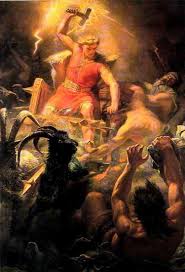
These, however, were not the static, codified stories written in books like those we pore over today. They had no one true version so that each word of the story could be pored over, examined and argued over. They were tales told around the campfire. They'd be embellished and exaggerated with each telling. Altered at the whim of the storyteller or at the behest of his audience. Truly a living tale and, with the potential for other tales to be created in the future, they were tales that imbued the protagonist with life. What would Thor do upon the next telling? Or the next?
When I read the Eddas, they can feel like an obituary. A recounting of the deeds of someone from the past. Great and glorious deeds, for certain. Deeds providing us with something to aspire to and lessons to be learnt, but deeds which are a fait accompli. Over. Something that was done in a world of the past, involving the people and events of the past and something I need to reassess for application in my own, contemporary world.
This is why I am beginning to feel that we have lost something very important by relying on the same, almost canonical stories from our mythology. A great mythology it is with much to benefit those who study it. But it is not as vibrant as it was when it came in the form of an oral tradition.
However the stories came about, whether the work of one or more skalds with an incredible imagination, the codified knowledge of a venerable gothi, the chronicles of ancient kings, gods, or whatever - that all seems to be of secondary importance to me. I enjoy the great mysteries as much as anyone. Philosophy and theology provide manna for my intellect that I would hate to have to do without. But I feel the stories themselves are so much more to so many more people. Accessible and of value to all, they encapsulate all that is good about heathenry and tell a damn good tale to boot.
I feel the stories need to be told again. Need to breathe and evolve. To escape from their current bondage within the written word and roam free as evolving, breeding entities.
Now, one problem, I foresee is that any skald brave enough to create his own Lay would doubtless come under an immense amount of flak from those for whom his portrayal of the gods and heroes in question didn't ring true. That is the way of contemporary heathenry, it seems - 'what I don't like shouldn't be...'. I can't imagine this happened all those moons ago. As I stated earlier, I feel that those stories that were less popular would simply fade away through natural selection.
This would also help to reinterpret heathenry in a modern context by creating stories of the gods and heroes at large in the modern world. It also might help heathenry reach a wider audience, too.
Obviously, I am biased, fancying myself as something of a Skald, but what I'd like to know is what kinds of stories about the gods and heroes would people want to hear around the campfire?
(images not part of original article)
Posted: Tue Jun 01, 2010 9:35 pm Post subject: Living gods
--------------------------------------------------------------------------------
I think one thing that is often a neglected part of our faith is one key difference between modern heathenry and its original form.
In times gone past, the stories of our faith were living things, evolving and growing with each progressive telling. Breeding, if you will, as new stories were created to join the old. Dying as less popular or lesser known stories were forgotten and blew away in the smoke of the campfire. When skalds told new tales of the gods and heroes, if those tales didn't sit right or were somehow wrong, then they simply would not be enjoyed and not remembered and retold. Good stories that added something to the fame of the god or hero or that simply entertained would be appreciated, remembered and retold.
These, however, were not the static, codified stories written in books like those we pore over today. They had no one true version so that each word of the story could be pored over, examined and argued over. They were tales told around the campfire. They'd be embellished and exaggerated with each telling. Altered at the whim of the storyteller or at the behest of his audience. Truly a living tale and, with the potential for other tales to be created in the future, they were tales that imbued the protagonist with life. What would Thor do upon the next telling? Or the next?
When I read the Eddas, they can feel like an obituary. A recounting of the deeds of someone from the past. Great and glorious deeds, for certain. Deeds providing us with something to aspire to and lessons to be learnt, but deeds which are a fait accompli. Over. Something that was done in a world of the past, involving the people and events of the past and something I need to reassess for application in my own, contemporary world.
This is why I am beginning to feel that we have lost something very important by relying on the same, almost canonical stories from our mythology. A great mythology it is with much to benefit those who study it. But it is not as vibrant as it was when it came in the form of an oral tradition.
However the stories came about, whether the work of one or more skalds with an incredible imagination, the codified knowledge of a venerable gothi, the chronicles of ancient kings, gods, or whatever - that all seems to be of secondary importance to me. I enjoy the great mysteries as much as anyone. Philosophy and theology provide manna for my intellect that I would hate to have to do without. But I feel the stories themselves are so much more to so many more people. Accessible and of value to all, they encapsulate all that is good about heathenry and tell a damn good tale to boot.
I feel the stories need to be told again. Need to breathe and evolve. To escape from their current bondage within the written word and roam free as evolving, breeding entities.
Now, one problem, I foresee is that any skald brave enough to create his own Lay would doubtless come under an immense amount of flak from those for whom his portrayal of the gods and heroes in question didn't ring true. That is the way of contemporary heathenry, it seems - 'what I don't like shouldn't be...'. I can't imagine this happened all those moons ago. As I stated earlier, I feel that those stories that were less popular would simply fade away through natural selection.
This would also help to reinterpret heathenry in a modern context by creating stories of the gods and heroes at large in the modern world. It also might help heathenry reach a wider audience, too.
Obviously, I am biased, fancying myself as something of a Skald, but what I'd like to know is what kinds of stories about the gods and heroes would people want to hear around the campfire?
Thursday, 22 November 2018
Wardruna at Manchester Albert Hall, 21st November 2018.
At this time of year, the veil between worlds is said to be at its thinnest. As Wardruna took to the stage to excited applause. Anticipation was palpable as a hush descended. The Lur sounded, and a thousand years melted away within the auditorium. This heralded what would sear into my memory as one of the most awe-inspiring sets I have ever witnessed.
In another blog (sometimes feels like another life), I wrote about Living Gods. I mentioned that contemporary heathenry was poorer for having only one, canonical version of our myths, caged within letters on a page. I mentioned that heathenry would never thrive until new stories were told and the gods and heroes of the folk inspired new arts and artists.
Wardruna are just such artists that give me hope for the future of our faith.
In another blog (sometimes feels like another life), I wrote about Living Gods. I mentioned that contemporary heathenry was poorer for having only one, canonical version of our myths, caged within letters on a page. I mentioned that heathenry would never thrive until new stories were told and the gods and heroes of the folk inspired new arts and artists.
Wardruna are just such artists that give me hope for the future of our faith.
Monday, 1 May 2017
Heathenry: All form and no content?
The following article was inspired by an experience our hearth had a few weeks ago. We had arranged to meet with people we'd met online at a fairly local moot. While we hadn't met any other members of this group before, we were looking forward to the meet up, as at least one of the attendees, the organiser, had shown themselves to be what we considered a good heathen and the kind of person we'd like to hang out with (not an accolade we bestow lightly).
The gods had other ideas, though. The day of the moot turned out to be one of the first sunny days of the year, spring having sprung a week or two earlier. Due to the nice weather, every man and his dog turned up to the meeting place. This would not, necessarily, be a problem - were it not for the very limited parking available. We drove around for quite some time, but to no avail. More and more people descended upon the area, bringing their unnecessarily large automobiles with them.
So, we left a message stating that, sadly, we wouldn't be able to attend and headed home. When we got back, it turned out the moot organiser had suffered the same problem and had also been unable to attend. Shame, but we all resolved to meet again next time.
All, that was, except one guy. Let's call him 'Bill'. Apparently, Bill had turned up and had been waiting for us all to arrive. Bill felt he had been unfairly put out by our failure to arrive. Despite the heavy traffic (and limited parking) being more than evident and despite our messages of explanation and apology, Bill decided to get massively butthurt over this.
It would seem being left alone on a beautifully sunny day had really aggravated him. Being made to attend a really nice pub with a very nice menu and good range of ales was probably the last straw.
To some extent, I can understand being a little annoyed. What I can't understand is leaving a really immature message on the group's online noticeboard and complaining that the organiser had let him down. I also recall some ad hominem attacks, if I am not mistaken. Seriously, this guy was whining like crazy over one lousy cancelled moot.
Thing is, looking at his profile on social media, he seemed to have given himself a really butch viking-style name (think 'Ragnar Thunderpants, or similar) and seemed to buy into the whole heathen/viking macho ideal. Perhaps not quite full on Brosatru, but getting there.
How can this guy think of himself as a modern, tough, stoic viking and then get really upset about a long drive to a nice pub near a beautiful park that didn't quite go to plan? Does Bill consider that hardship? He should try crossing the Atlantic in a longship...
This really has me worried now that a much greater proportion of the heathen community than I had previously thought are precisely this kind of immature, 'dummies out of the pram' style whinger.
To me, one of the most important things that attracted me to heathenry in the first place was the fact that it actively discouraged this kind of attention-seeking, diva-like behaviour. I'm not saying I want a mindless, Rambo-esque Brosatru hearth or moot, but just no-one that needs suckling before we can get to the proper business of drinking and setting the world to rights.
Too much to ask?
The gods had other ideas, though. The day of the moot turned out to be one of the first sunny days of the year, spring having sprung a week or two earlier. Due to the nice weather, every man and his dog turned up to the meeting place. This would not, necessarily, be a problem - were it not for the very limited parking available. We drove around for quite some time, but to no avail. More and more people descended upon the area, bringing their unnecessarily large automobiles with them.
So, we left a message stating that, sadly, we wouldn't be able to attend and headed home. When we got back, it turned out the moot organiser had suffered the same problem and had also been unable to attend. Shame, but we all resolved to meet again next time.
All, that was, except one guy. Let's call him 'Bill'. Apparently, Bill had turned up and had been waiting for us all to arrive. Bill felt he had been unfairly put out by our failure to arrive. Despite the heavy traffic (and limited parking) being more than evident and despite our messages of explanation and apology, Bill decided to get massively butthurt over this.
It would seem being left alone on a beautifully sunny day had really aggravated him. Being made to attend a really nice pub with a very nice menu and good range of ales was probably the last straw.
To some extent, I can understand being a little annoyed. What I can't understand is leaving a really immature message on the group's online noticeboard and complaining that the organiser had let him down. I also recall some ad hominem attacks, if I am not mistaken. Seriously, this guy was whining like crazy over one lousy cancelled moot.
Thing is, looking at his profile on social media, he seemed to have given himself a really butch viking-style name (think 'Ragnar Thunderpants, or similar) and seemed to buy into the whole heathen/viking macho ideal. Perhaps not quite full on Brosatru, but getting there.
How can this guy think of himself as a modern, tough, stoic viking and then get really upset about a long drive to a nice pub near a beautiful park that didn't quite go to plan? Does Bill consider that hardship? He should try crossing the Atlantic in a longship...
This really has me worried now that a much greater proportion of the heathen community than I had previously thought are precisely this kind of immature, 'dummies out of the pram' style whinger.
To me, one of the most important things that attracted me to heathenry in the first place was the fact that it actively discouraged this kind of attention-seeking, diva-like behaviour. I'm not saying I want a mindless, Rambo-esque Brosatru hearth or moot, but just no-one that needs suckling before we can get to the proper business of drinking and setting the world to rights.
Too much to ask?
Labels:
attitudes,
brosatru,
character,
discipline,
event,
hearth,
heathen values,
heathenry,
lifestyle,
modern heathenry,
neopaganism,
pragmatism,
strength
Location:
Lancashire, UK
Sunday, 25 September 2016
Vikings - A help or hindrance to heathens?
There is no doubt that there has been a huge resurgence of interest in Vikings of late. The Vikings series and a smattering of films (not all Marvel) have seen some success and, at the very least, have made the public aware of names like Thor and Ragnar Lothbrok.
But, what effect has this really had on heathenry? If I were to tell a stranger tomorrow that I am a heathen, would they expect me to be a bloodthirsty warrior like Ragnar and company, or maybe a comic-book nerd who fantasises about spacefaring gods with superpowers?
With the huge number of viking memes and groups on social media, and adverts for t-shirts, drinking horns and replica axes, they could be forgiven for thinking that, as a heathen, I long to disembowel someone with a sword, just to get into Valhalla. After all, fighting all day and feasting all night is all a good heathen wants, isn't it?
Well, no. Actually, it isn't. Personally, I'd just like to spend as much peaceful time with my family and friends as I possibly can. In this life and the next. Academia would seem to suggest that arch-heathens would have agreed with me, too. There is a growing belief that Valhalla was more of a consolation prize for heathens who died abroad during raiding missions. As they couldn't be buried in their family burial mounds, Valhalla was the spiritual equivalent of a Bendy Bully and bus fare home, rather than getting to win the luxury speedboat of the afterlife.
Plus, even if I did die in battle, Odin essentially takes the leftovers back to Valhalla. Freyja gets first pick of half the battle slain and takes them to Folkvangr, her meadow. Where I would imagine a much nicer time is had by all. Got nothing against Odin, but surely fighting all day every day is gonna get old pretty fast - no matter how bloodthirsty you were when you first died.
Some of my best 'heathen moments' are simply talking with my wife and daughter over the Sunday lunch table. Family time like that just as heathen in my eyes, and considerably more acceptable to contemporary society that blood-eagling your neighbours cos they parked across your drive without asking you.
But, what effect has this really had on heathenry? If I were to tell a stranger tomorrow that I am a heathen, would they expect me to be a bloodthirsty warrior like Ragnar and company, or maybe a comic-book nerd who fantasises about spacefaring gods with superpowers?
With the huge number of viking memes and groups on social media, and adverts for t-shirts, drinking horns and replica axes, they could be forgiven for thinking that, as a heathen, I long to disembowel someone with a sword, just to get into Valhalla. After all, fighting all day and feasting all night is all a good heathen wants, isn't it?
Well, no. Actually, it isn't. Personally, I'd just like to spend as much peaceful time with my family and friends as I possibly can. In this life and the next. Academia would seem to suggest that arch-heathens would have agreed with me, too. There is a growing belief that Valhalla was more of a consolation prize for heathens who died abroad during raiding missions. As they couldn't be buried in their family burial mounds, Valhalla was the spiritual equivalent of a Bendy Bully and bus fare home, rather than getting to win the luxury speedboat of the afterlife.
Plus, even if I did die in battle, Odin essentially takes the leftovers back to Valhalla. Freyja gets first pick of half the battle slain and takes them to Folkvangr, her meadow. Where I would imagine a much nicer time is had by all. Got nothing against Odin, but surely fighting all day every day is gonna get old pretty fast - no matter how bloodthirsty you were when you first died.
Some of my best 'heathen moments' are simply talking with my wife and daughter over the Sunday lunch table. Family time like that just as heathen in my eyes, and considerably more acceptable to contemporary society that blood-eagling your neighbours cos they parked across your drive without asking you.
Subscribe to:
Posts (Atom)


